Two buildings can both contain asbestos and carry very different risks. Sealed cement panels on an outbuilding nobody touches are not the same as damaged pipe lagging in a boiler room the caretaker visits every day. When there is more than one asbestos-containing material (ACM), you cannot tackle them all at once, and you need a fair way to decide what comes first. HSE's scoring system gives you one, and a written score makes your reasoning clear to anyone who asks.
Summary of HSE guidance, not legal advice. Scoring tables reproduced from HSE's HSG227, A comprehensive guide to managing asbestos in premises (Appendices 2 and 3), public sector information licensed under the Open Government Licence v3.0.
Two parts: material and priority
HSE says the risk assessment includes a material assessment, which looks at the type and condition of the ACM and how easily it would release fibres if disturbed, and a priority assessment, which looks at the likelihood of someone disturbing it. The two scores are added together to give the overall risk assessment, which you can compare across ACMs to build your action plan (HSE HSG227).
Part 1: the material assessment
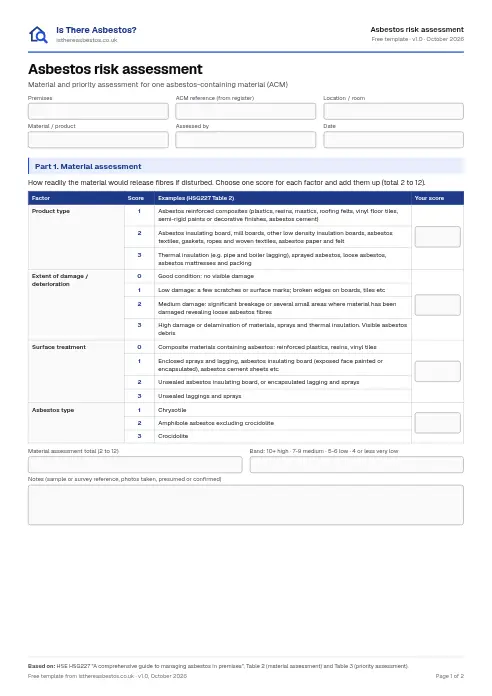
HSG227 reproduces the algorithm from MDHS100. It scores four factors and adds them to a total between 2 and 12:
| Factor | Scores |
|---|
| Product type | 1 (e.g. asbestos cement, vinyl floor tiles) to 3 (e.g. pipe lagging, sprayed asbestos) |
| Extent of damage | 0 (good condition) to 3 (high damage, visible debris) |
| Surface treatment | 0 (composites) to 3 (unsealed lagging and sprays) |
| Asbestos type | 1 (chrysotile), 2 (amphiboles excluding crocidolite), 3 (crocidolite) |
HSE bands the total: 10 or more high risk, with significant potential to release fibres if disturbed; 7 to 9 medium; 5 to 6 low; 4 or less very low. If the asbestos type has not been confirmed by analysis, ask your surveyor how they have scored it.
Part 2: the priority assessment
HSE stresses that the highest material score is not automatically the top priority. The priority assessment considers four headings, each scored 0 to 3: normal occupant activity, likelihood of disturbance (location, accessibility, extent), human exposure potential (number of occupants, how often the area is used, how long for) and maintenance activity (type and frequency). Where you use more than one factor under a heading, average them, rounding up. HSE says maintenance activity is the first and most important factor, because maintenance trades such as plumbers and electricians are the group the duty to manage is mainly trying to protect (HSE HSG227).
HSE says that even if your survey report includes a priority assessment, you need to validate it, because only you know what happens in your building (HSE).
When the scores are close
HSG227 gives the example of a boiler house with lagging in poor condition scoring about the same overall as an office with insulating board in reasonable condition: the boiler house scores higher on material, the office higher on priority because it is occupied more often. You might do the office first because it is used daily, or the boiler house first because of the condition. HSE says algorithms are best guesses and will often need your own judgement, and that if the office were a classroom, the young age of the occupants might decide it (HSE HSG227). Record your reasoning in the decision box.
How to use the template
- Identify the material. Record the premises, the ACM reference from your register, the location and the product.
- Score the material assessment. Score product type, extent of damage, surface treatment and asbestos type using HSE's table. Your surveyor usually provides this.
- Score the priority assessment. Score occupant activity, likelihood of disturbance, human exposure potential and maintenance activity. Average the factors under each heading, rounding up.
- Add them together. Material score plus priority score gives the overall risk score to compare ACMs and set priorities.
- Decide and record the action. Choose the action, the due date and the next condition check, and copy the scores into your asbestos register.
Then copy the scores and action into your register. Our asbestos management plan template has a register with columns for both.
Questions
What is an asbestos risk assessment?
HSE says you must include a risk assessment in your asbestos register to identify and prioritise ACMs that need remedial action. It combines a material assessment, how readily the material would release fibres, with a priority assessment, how likely it is to be disturbed (HSE).
Who carries out the risk assessment?
The surveyor usually provides the material assessment in the survey report. HSE says that even if the report includes a priority assessment you still need to validate it, because only you know what happens in your building. As dutyholder, you make the risk assessment.
How is the material assessment scored?
HSG227 scores four factors: product type (1 to 3), extent of damage (0 to 3), surface treatment (0 to 3) and asbestos type (1 to 3). The total of 2 to 12 is banded: 10 or more high risk, 7 to 9 medium, 5 to 6 low, and 4 or less very low.
How is the priority assessment scored?
HSG227 uses four headings: normal occupant activity, likelihood of disturbance, human exposure potential and maintenance activity. Each factor is scored 0 to 3. Where you use more than one factor under a heading, average them, rounding up, then add the four heading scores.
Does a high score mean the asbestos must be removed?
Not necessarily. HSE says ACMs in good condition that are unlikely to be disturbed are usually safer left in place and managed. Damaged ACMs must be repaired, protected, sealed or removed, and some work needs an HSE-licensed contractor (HSE). See licensed vs non-licensed work.
Is this the same as a risk assessment for asbestos work?
No. This template assesses ACMs in your premises for the duty to manage. Anyone carrying out work on asbestos needs their own risk assessment for that work.
Request a survey quote Management plan template
Related: Register and plan explained · Management surveys · Licensed vs non-licensed work