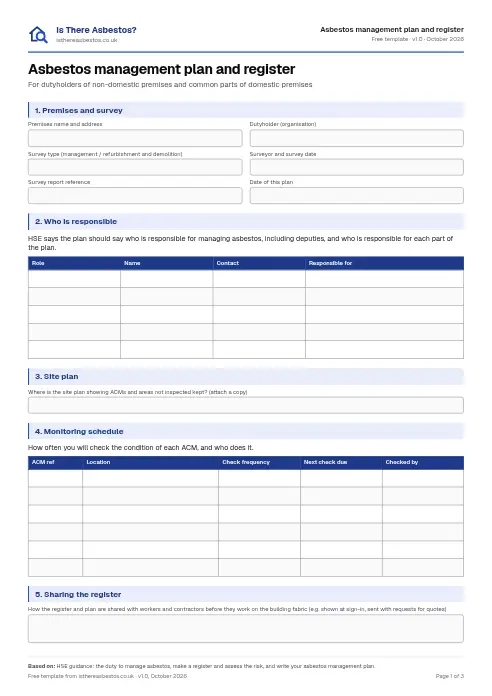
You have the survey report: pages of photos, sample numbers and material scores. Now the law expects you to turn it into something people actually follow, so that the electrician running cable through a ceiling void next spring is told about the insulating board above the tiles before the drill comes out. That is all an asbestos management plan really is. This template walks you through it, section by section, in the order HSE sets out.
Summary of HSE guidance, not legal advice. Each requirement links to the HSE page it comes from. For the full explanation of the register and plan, see our asbestos register and management plan guide.
What HSE says the plan must include
HSE says your asbestos management plan should include (HSE: write your asbestos management plan):
- who is responsible for managing asbestos, including deputies (template section 2)
- your asbestos register, including a site plan showing where ACMs are and areas not inspected (sections 3 and 6)
- the schedule for monitoring the condition of ACMs (section 4)
- how you will share the register with workers or contractors doing maintenance work (section 5)
- control arrangements to make sure ACMs are not disturbed (section 7)
- emergency procedures if ACMs are disturbed (section 8)
It should be site-specific, say who is responsible for each part, and be easy to read, update and find. It can be on paper or electronic.
How to fill it in
- Start from your survey. Fill in the premises, survey type, surveyor, date and report reference. Most dutyholders start with a management survey.
- Name who is responsible. Record the person responsible for managing asbestos, their deputies, and who looks after each part of the plan.
- Build the register. Copy every known and presumed ACM from the survey report: location, product, extent, condition, inspection date, and the material and priority scores.
- Decide the action for each ACM. Leave and manage, label, repair, seal, enclose or remove, each with a due date. Record when it is done.
- Set the monitoring schedule. Decide how often each ACM is checked and who checks it, and write down the next due date.
- Write how you share it and control work. How contractors see the register before they start, how work on the building fabric is controlled, and what happens in an emergency.
- Review it. Review at least every 12 months and whenever something changes. Log each review on page 3.
The register: what each column is for
As a minimum, HSE says your register should record all known and presumed ACMs, their type, how much there is and its condition, the dates of the original and last inspection, and the material and priority assessment for each one, plus any locations presumed to contain asbestos because they could not be accessed (HSE: make a register and assess the risk). HSE adds that photographs, actions with due dates, evidence that actions were completed, and the next condition check all help. The template's register has a column for each. To work out the two scores, use our free asbestos risk assessment template.
Deciding what to do with each ACM
HSE says to give high priority to damaged ACMs and those likely to be disturbed, and to consider planned work on the building such as service installations and net zero improvements. ACMs in good condition and unlikely to be disturbed are usually safer left in place and managed, with regular inspections. Damaged ACMs must be repaired, protected, sealed or removed. Actions should be clear, time-based and reviewed (HSE). Some work needs an HSE-licensed contractor (HSE); see licensed vs non-licensed work.
Sharing it
HSE says you must tell site or building managers, employees, contractors and maintenance workers about the plan, and tell workers before they start work on the fabric of the building, including builders, roofers, decorators, plumbers, gas fitters and electricians. For planned work, share it as early as possible, for example when you ask for a quote. Emergency services should also be given the location and condition of known ACMs (HSE: provide information).
Keeping it alive
Update the register at least once a year, or sooner if anything changes the risk (HSE). Review the plan when work affects ACMs, when staff with management responsibilities change, after accidental disturbance and after scheduled condition checks (HSE). The review log on page 3 gives you a dated record that you did.
Questions
Who needs an asbestos management plan?
The dutyholder for non-domestic premises, such as shops, offices and factories, and for the common parts of multi-occupancy domestic premises, such as purpose-built flats. HSE says the dutyholder must write an asbestos management plan, put it into action, monitor it and review it every 12 months or sooner if necessary (HSE).
What must an asbestos management plan include?
HSE lists who is responsible for managing asbestos, including deputies; the asbestos register with a site plan showing ACMs and areas not inspected; the schedule for monitoring ACM condition; how you will share the register with workers and contractors; control arrangements to stop ACMs being disturbed; and emergency procedures (HSE).
What is the difference between the register and the plan?
The register is the record of where asbestos is, what it is and its condition. The plan sets out how you will manage it: who is responsible, the actions, monitoring, sharing information, controlling work and emergencies. HSE describes the register as a key part of the plan.
How often should the plan be reviewed?
At least every 12 months, and HSE says also whenever work takes place that affects ACMs, when staff with management responsibilities change, when ACMs are disturbed by accident, and after scheduled condition checks (HSE).
Does HSE have its own template?
Yes. HSE publishes free example and blank registers and management plans, which we link on our register and management plan guide. Ours puts the plan, register, monitoring and review log in one fillable pack, with HSE's requirements as prompts.
Can I write the plan without a survey?
You can start one, but HSE says any area that has not been inspected has to be presumed to contain asbestos until it can be. Without a survey, the register has little reliable to record. Request a survey quote.
Request a management survey quote Risk assessment template
Related: Register and plan explained · Duty to manage for landlords · Commercial surveys · Management surveys